Wednesday, October 8, 2014

Underwood Electric: Blast it! (And a survey)

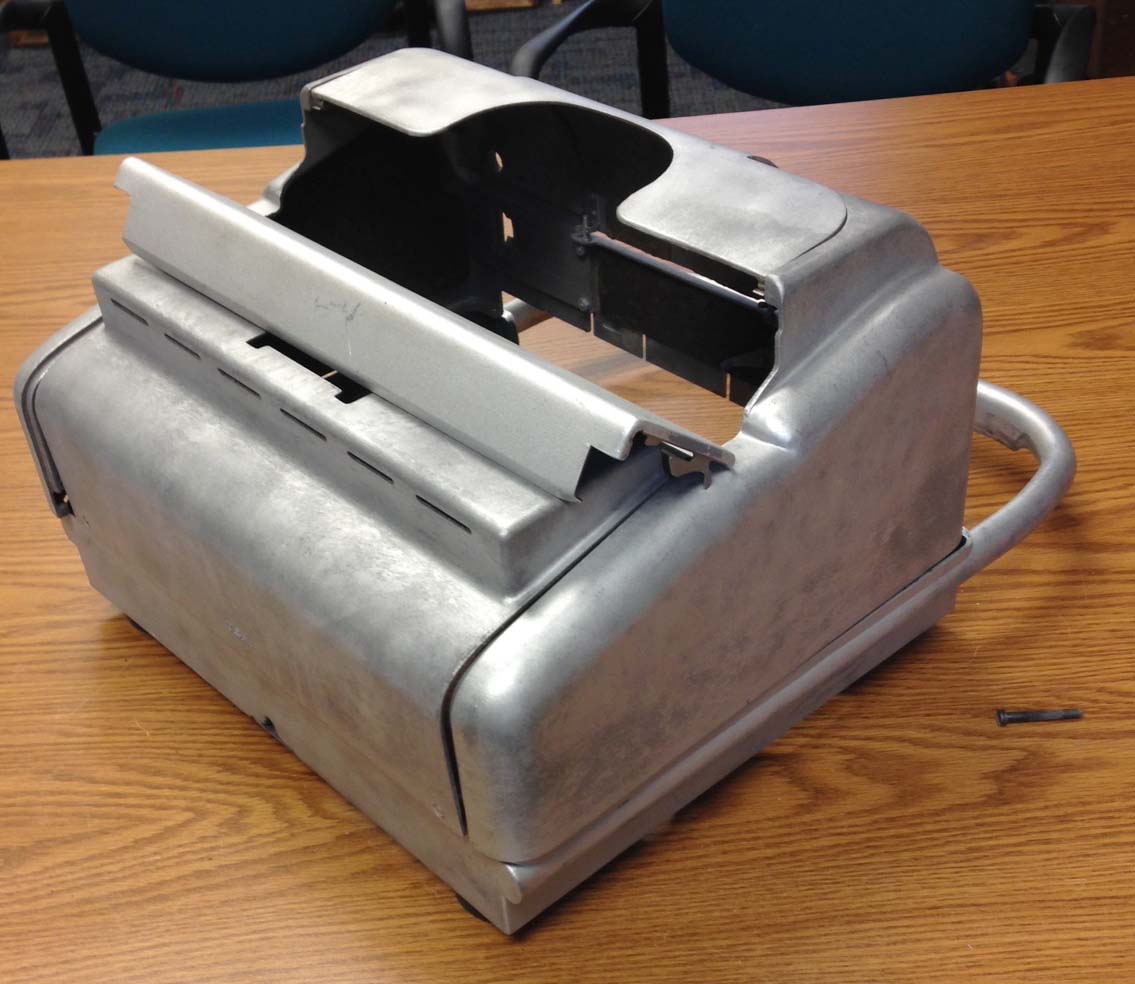
What to do with this dirty shell now that I've removed it from the Underwood Electric?


Happily, my university's Physics department maintains a nice machine shop including this blasting cabinet:


This is an inside view. You slip your hands into the gloves so you can handle the sandblasting gun and the pieces. The cabinet uses a fan to vent any dust, and recycles the abrasive. 


This is the view you get while working. Just watch as the paint is gradually erased.


— And the result:


A little steel wool and Mother's polish can make the surface smoother and shinier:


Now, just for fun (i.e. I am not promising to obey the will of the people), let's have a survey on what I should do with these body pieces. Most of the survey options are based on readers' suggestions in comments so far, and you also have the chance to make further suggestions.

Take the survey here.


It will close about 48 hours after the time of this post.

Monday, October 6, 2014

Underwood Electric: disassembly

After bringing home the massive stinker described in yesterday's post, I couldn't resist cracking it open.

I soon discovered that the back panel lifts right off, revealing a brawny GE motor (right) and a unit on the left that translates the rotation of the motor into the faster rotation of a belt. This unit also winds up the strap that pulls the carriage back when you hit the left or right return key. When I got the typewriter, the motion of this strap was very sluggish. After removing a panel I was able to clean the unit with good ol' Lectra-Motive Electric Parts Cleaner, which freed up this essential function.


The big black base / front frame came off pretty easily once I removed 8 bolts. 
By the way, below you can see the distinctive Underwood Electric ribbon spools. Essentially, the machine uses the system invented by the Noiseless Typewriter Company back in the teens, which was adopted by Remington on their noiseless machines and (postwar) on all their machines. This mechanism was shared with Underwood when the two companies made a deal on the manufacture of nearly-identical noiseless typewriters in the 1930s.


Just look at this gorgeous mechanical complexity. Much of the mechanism on the left of the typewriter is devoted to the shift.


Let's watch it in action.


Here's the mechanism on the right side. The thing looks like a miniature tank!


The belt drives a spinning shaft that provides power to nearly all the typewriter's functions. This is a fluted metal shaft, not a rubber-covered roller as on the IBM and many other electric typewriters. The Woodstock Electrite also uses a fluted shaft, but mine is much noisier than this Underwood, which is remarkably quiet.


This machine is fast and has a power spacing function that you can see in this video. Currently the tabulator and backspace aren't working.


There's impressive complexity and robustness at every turn, such as at the right end of the carriage:


This machine follows in the footsteps of the IBM Electromatic: 
built to military-grade toughness with no regard for portability.


Behold the beauty of 1940s engineering:


And here's the shell:


In our next installment:
blasting away!


Sunday, October 5, 2014

Craigslist strikes again

What could it be?


An Underwood Electric from Craigslist!


The price was right—$25.00—and I couldn't resist.
The seller used it for years at a furniture store, starting in the '70s (when it was already 20 years old).


Too bad it smells like a catbox ...


... and types about as well as one, too.


This thing is staying in the garage until I can get it to stop reeking.


A first step is Scrubbing Bubbles.


Aha, it's not brown but gray.


Now it's looking a bit more presentable. But this creature is going to need some serious work. And there's a good chance I'll strip the paint right off. 


Should I give it the H. R. Giger treatment?

To be continued ...