

The Tachotype is a really cute Dutch stenotype. I had one for a while.

The products of Talleres Alonso in Valencia, Spain include the Andina Nova, Alondra, Talbos, and Sabater. More information in ETCetera No. 86.


I featured the Taylorix Zeilomatik on my blog a few years ago, but I think this hulking machine still counts as obscure.

The Telautoprint, known to me only from this illustration, was one of many admirable and failed attempts to develop a teletype.

Same goes for the Telescriptor.

But here is a more successful Teletype Perforator. (I know, these aren't "typewriters," but you're interested, right?)

Here is a Thurber (or a reproduction of one?) along with an artist's idea of how the pioneering Mr. Thurber might have been viewed by conventional scribes.


Another invention is Thurber's Patent Kaligraph. Absolutely not a typewriter, but a device for replicating handwriting. Grab one if you see one.

Here's an Alpina, right? No, it's a TOPS P-2.


Toyo made the Condor, Jaguar, Rexina, and other obscure and fragile portables.

The Toyriter is ... well, just what it says it is.

The Trebla is an index typewriter you can clamp onto a table.

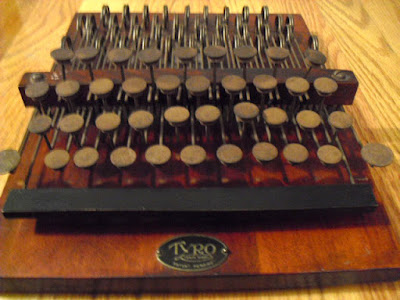
This Tyro is a practice keyboard.
The only Uarda I've ever seen looks delicate:

This Unic is obviously a clone of the Mignon, but is it a name variant of another clone, such as the Heady? I don't know.

This Unica may really be unique; there is no record of it anywhere but in this photo taken in Barcelona. The name is off-center and I wonder whether this was mass-produced or not. Certainly not in large numbers.

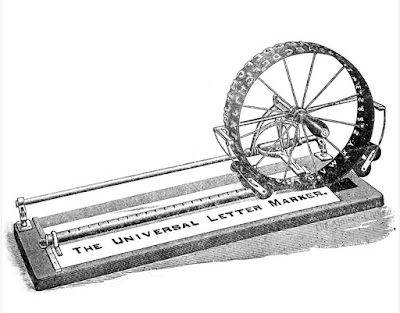
The Universal Letter Marker didn't have the nerve to call itself a typewriter.
But the Universal Type-Writer did, even though it was really just a printing kit (as I suspect the Samtico was—see previous post).


The Univex is a minor Spanish index machine.

The Velographe would be a great addition to any collection.

The Virocyl is a cute little index machine from France (I believe).

The Vision 2000: ordinary, yet very uncommon.

Here's a beautiful Victoria from Spain ...

... not to be confused with this Vittoria from Italy.

And finally, a Vornado:


The products of Talleres Alonso in Valencia, Spain include the Andina Nova, Alondra, Talbos, and Sabater. More information in ETCetera No. 86.


I featured the Taylorix Zeilomatik on my blog a few years ago, but I think this hulking machine still counts as obscure.
The Telautoprint, known to me only from this illustration, was one of many admirable and failed attempts to develop a teletype.

Same goes for the Telescriptor.
But here is a more successful Teletype Perforator. (I know, these aren't "typewriters," but you're interested, right?)

Here is a Thurber (or a reproduction of one?) along with an artist's idea of how the pioneering Mr. Thurber might have been viewed by conventional scribes.


Another invention is Thurber's Patent Kaligraph. Absolutely not a typewriter, but a device for replicating handwriting. Grab one if you see one.

Here's an Alpina, right? No, it's a TOPS P-2.

Toyo made the Condor, Jaguar, Rexina, and other obscure and fragile portables.

The Toyriter is ... well, just what it says it is.

The Trebla is an index typewriter you can clamp onto a table.

This Tyro is a practice keyboard.

The only Uarda I've ever seen looks delicate:
This Unic is obviously a clone of the Mignon, but is it a name variant of another clone, such as the Heady? I don't know.

This Unica may really be unique; there is no record of it anywhere but in this photo taken in Barcelona. The name is off-center and I wonder whether this was mass-produced or not. Certainly not in large numbers.

The Universal Letter Marker didn't have the nerve to call itself a typewriter.

But the Universal Type-Writer did, even though it was really just a printing kit (as I suspect the Samtico was—see previous post).
The Univex is a minor Spanish index machine.

The Velographe would be a great addition to any collection.

The Virocyl is a cute little index machine from France (I believe).

The Vision 2000: ordinary, yet very uncommon.

Here's a beautiful Victoria from Spain ...

... not to be confused with this Vittoria from Italy.

And finally, a Vornado:


